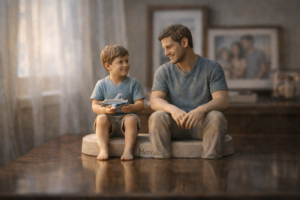
There is a photograph taken somewhere in New England on July 4, 1876. A family stands in front of a painted backdrop – stiff collars, serious faces, hands at their sides. The Centennial had been declared the greatest celebration in American history. President Grant had opened the World’s Fair in Philadelphia. Fireworks lit the sky over every major city.
The family in the photograph is not in Philadelphia. They are in their yard. One of the men is holding what appears to be a small flag. Nobody is smiling – not because they were unhappy, but because that is how you stood for a photograph in 1876.
That image still exists. Someone kept it.
One hundred and fifty years later, you are about to stand in your own yard on your own July 4th. The question every generation faces is the same: how do we hold onto this?
The United States will turn 250 on July 4, 2026. The America250 Commission, established by Congress in 2016, and the White House Freedom250 task force have spent years building a calendar of events to match the scale of the occasion – parades, cultural retrospectives, museum installations, and civic programming that stretch through the entire year.
Official messaging calls it “the most important milestone in our country’s history.” That is not marketing language. No living American has witnessed this before. Nobody at this year’s celebration will be alive for the Tercentennial.
The Bicentennial of 1976 set the benchmark. That year, the country threw itself into a summer of re-examination. The Tall Ships sailed into New York Harbor. Fireworks were longer, louder, more deliberate than usual. Time magazine ran a July 4th cover with a question most Americans were actively asking after Vietnam and Watergate: what does it mean to still love this country? Families gathered anyway. They gathered around the grill, watched the sky light up, and captured moments now tucked away in shoeboxes or stored on old scanners.
The semiquincentennial celebration arrives fifty years later, in a country that is once again in the middle of asking large questions about itself. That is not a coincidence – it is what anniversaries do. They create the conditions for reflection. They make people want to gather, mark the moment, and leave something behind.
Every generation that has lived through a major Independence Day anniversary has tried to solve the same problem with the tools available to it.
| Anniversary | Year | How Families Marked It | What Survived |
|---|---|---|---|
| Centennial | 1876 | Formal portrait photography, embroidered samplers, commemorative plates | Photographs, pressed flowers in books, ceramic pieces |
| Sesquicentennial | 1926 | Home film reels, postcard collections, local newspaper supplements | Film reels (mostly deteriorated), newspaper clippings, some postcards |
| Bicentennial | 1976 | Super 8 home movies, commemorative coins, mass-produced poster art | Coins, select photographs, very few home films with working playback |
| Semiquincentennial | 2026 | Digital photography, short-form video, personalized 3D figurines, America250 memorabilia | TBD – but the physical will outlast the digital |
Each era had its version of a keepsake. Each era also had its version of a format that seemed permanent and turned out to be less so. The Kodachrome slides from 1976 are exquisite – and require a projector most households no longer own. The Super 8 reels are irreplaceable – and the transfer services charge by the foot.
What actually made it through every generation was simpler: things that could sit on a shelf without requiring a device.
“Every generation that lived through a major American anniversary tried to solve the same problem with the tools it had. The question for 2026 is not whether to mark the moment – it is how.”
There is a paradox at the center of how we document our lives today.
Americans collectively take approximately 5 billion photographs every single day. The average person carries around 2,300 images on their phone at any given time. And yet studies show that most people view fewer than 5% of their stored images more than once.
We are saving everything. We are savoring almost nothing.
It gets more complicated. Research on digital media and memory retention shows that the act of taking a photo can actually impair your ability to remember the moment itself. When we outsource the memory to the camera, our brain steps back from encoding it. You photograph the fireworks. You forget the fireworks.
Approximately 54% of Americans report feeling overwhelmed when trying to locate a specific photo in their digital archives. National Geographic has noted that infinite storage has effectively stripped individual memories of their weight – when everything is saved, nothing feels worth saving.
This is the problem that every family celebrating July 4, 2026 will face, whether they know it or not.
The answer is not to stop photographing. The answer is to also create something you can hold.
Research published by the Association for Psychological Science found that haptic memory – memory formed through touch – produces remarkably durable results. In studies, blindfolded participants correctly identified 94% of objects by touch alone immediately after handling them. One week later, without any review, they still recalled 84% correctly.
By contrast, a photograph viewed once and stored among thousands of others leaves almost no lasting trace.
Neuroscience further confirms that emotionally charged experiences activate the amygdala, which strengthens memory encoding and retrieval. A July 4th BBQ with three generations of family around a table is exactly the kind of emotionally significant event that gets encoded deeply – if you give it something physical to anchor to.
According to Mather’s object-based memory framework, emotionally significant objects attract sustained attention and become tightly bound with the memories surrounding them. A figurine of your family at this celebration does not just represent the moment – it becomes the retrieval cue for the entire experience every time someone picks it up.
There is also what psychologists call the reminiscence bump. Research shows that people disproportionately recall memories formed between the ages of 10 and 30 when they look back on their lives from older age. The child at your 2026 celebration who is 12 years old today will carry this memory into their adult life at an unusually high rate of retention – if the memory has something physical to return to.
There is a quiet shift happening in how people treat memory.
Not loudly. Not as a trend. But consistently.
People are beginning to ask:
This is where the idea of selective preservation becomes important.
Instead of saving everything, people are choosing:
This is why objects – especially ones that reflect real people – are returning to the center of how we remember. The US personalized gifts market reached $8.9 billion in 2024 and is growing at approximately 9% annually, driven by exactly this shift toward meaning over volume.
The endowment effect plays a role here too. Studies in psychological economics show that people assign significantly higher value to objects that carry their identity or likeness – and are far less likely to discard them. A personalized keepsake is not just an object. It is, psychologically speaking, already owned the moment it is received.
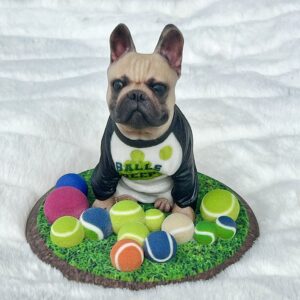
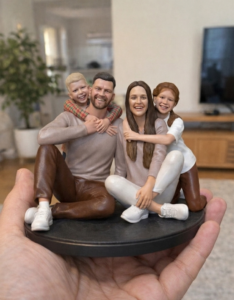
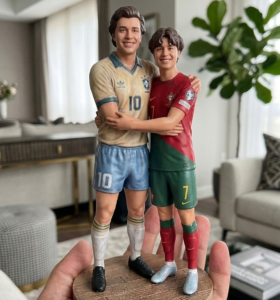
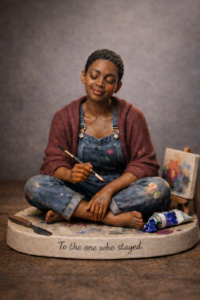
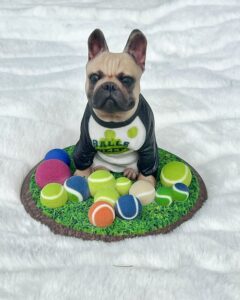
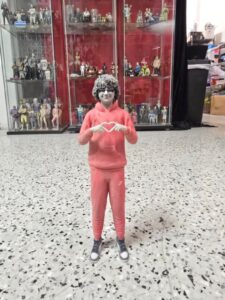
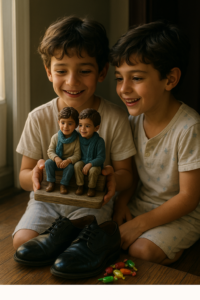
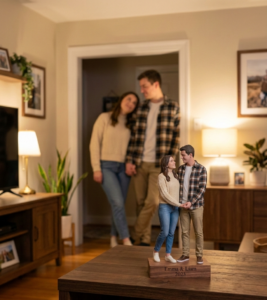
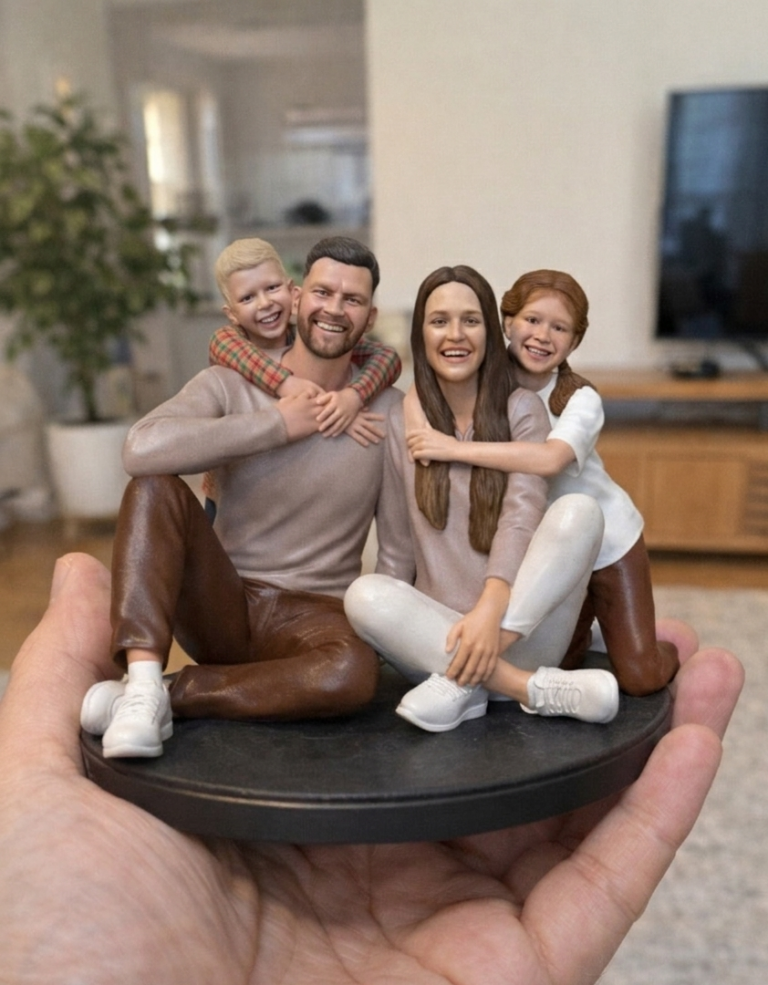
The3DMe is a custom 3D figurine studio. It transforms customer-submitted photographs into hand-finished, full-color resin sculptures – the same people, the same faces, captured in three dimensions at a specific moment in their lives.
The process is precise and entirely built around the photograph you already have:
The material distinction matters. Full-color resin has redefined what custom figurines can achieve compared to earlier sandstone and powder-based methods. Modern photopolymer technology enables precise detail, accurate skin tones, and smooth, refined finishes that closely resemble real-life presence. The global photopolymer resin market surpassed $3 billion in 2024, reflecting rapid adoption of high-resolution, full-color 3D printing across industries.
For customers in the United States and Canada – the largest markets for personalized figurines – The3DMe fulfills through a Canada-based production partner, ensuring reliable delivery without compromising quality.
The custom figurine space today spans a wide spectrum.
At one end are fast, automated services that rely on scanning or algorithms to generate quick, generic outputs. At the other is The3DMe’s approach – where every piece is carefully hand-sculpted by a professional artist using your photographs as reference, built in the same advanced tools used in film and game character design.
The difference becomes clear in the details.
Automated methods can create a general resemblance. Hand sculpting captures the individual – the exact curve of a smile, the way someone naturally stands, the clothing they chose on a specific day. It is not just about looking similar. It is about recognizing the moment and the person within it.
This is why The3DMe’s figurines are created with accuracy in proportion and expression, allowing them to feel personal, grounded, and lasting – pieces that belong in a home, not just on an occasion.
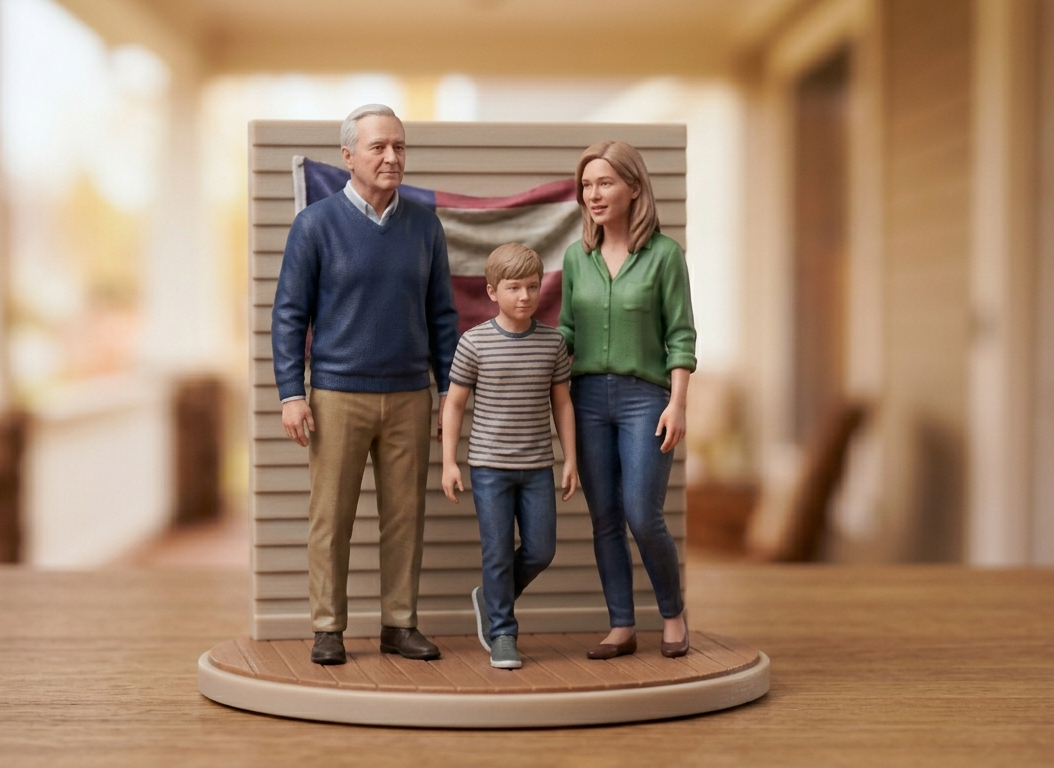
The family in that 1876 photograph didn’t think they were preserving history—they just knew the moment mattered.
150 years later, it still exists because someone chose to keep it. It named someone. A real family, in a real place, on a real day.
July 4, 2026 will be no different. You’ll take photos—but only some things will be kept.
The ones that last are always the same—specific, recognizable, tied to someone.
That’s where The3DMe fits in.
We don’t replace the photograph—we build from it. Hand-sculpted, full-color resin pieces that hold the moment clearly, so it can be returned to years later. If you’re ready to turn your photo into something lasting, you can explor on The3DMe’s website
And if you want to see how these moments look in real life—real families, real likenesses—you can browse The3DMe’s work on Instagram.
Because not everything needs to last.
Just the things that matter.